Everything the engine does, section by section.
No marketing abstractions. Each block below maps to a page or a module in the app, and says what it measures and where the number comes from. Everything applies to USDT-margined perpetual contracts, Binance USDⓈ-M perpetuals, Bybit linear perpetuals and MEXC perpetuals, traded with isolated margin. Spot, options and coin-margined contracts are out of scope.
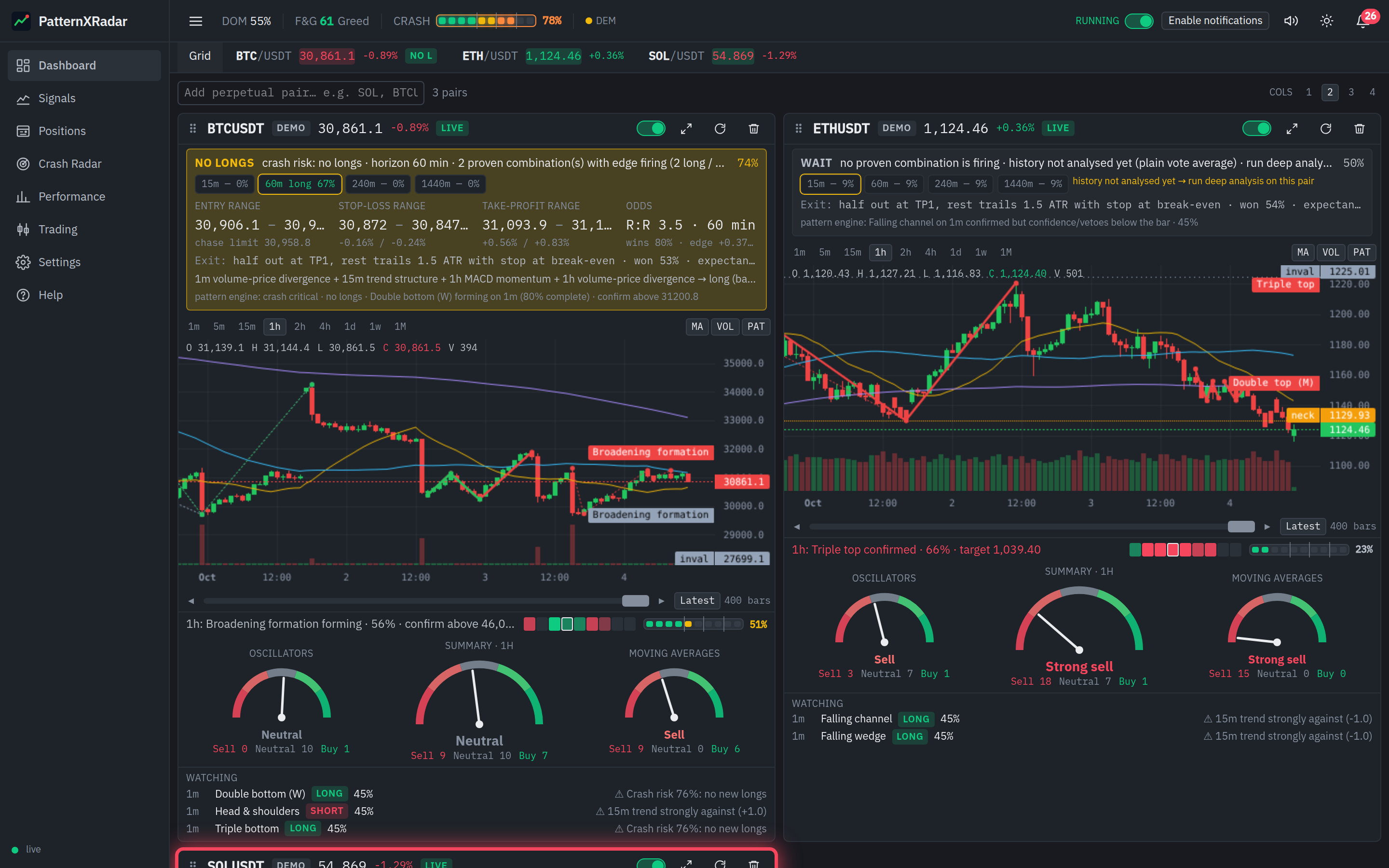
One grammar, nine timeframes, five scales each.
Patterns are defined on swing points, not raw candles, so the same detector works on a one-minute chart and a monthly one. An ATR-relative ZigZag at five reversal thresholds produces a tree of swings; a scale-4 W knows which scale-1 Ms live inside it.
- Reversal. W / double bottom and M / double top with Adam-and-Eve, spring and higher-low variants; triple tops and bottoms; head and shoulders both ways; rounding; cup and handle; Wyckoff spring and upthrust; V climaxes.
- Continuation. Ascending, descending and symmetrical triangles; rising and falling wedges; flags and pennants; rectangles with breakout versus fakeout; channels; broadening formations.
- Confirmation. Candlestick patterns on the last one to three bars and regular or hidden divergences on RSI, MACD, OBV, CVD and open interest.
- Outcome labels. Each historical instance records whether 0.5x, 1x, 1.5x and 2x of its height were reached before invalidation, MFE, MAE and bars to target, plus a snapshot of fifty-plus features at completion.
- Stage
- forming → at trigger → confirmed → failed, with completion percent and a quality score for symmetry, volume and cleanliness
- Context
- Each instance is tagged with the higher-timeframe regime and any enclosing pattern one or two frames up
Combinations that won here get the vote.
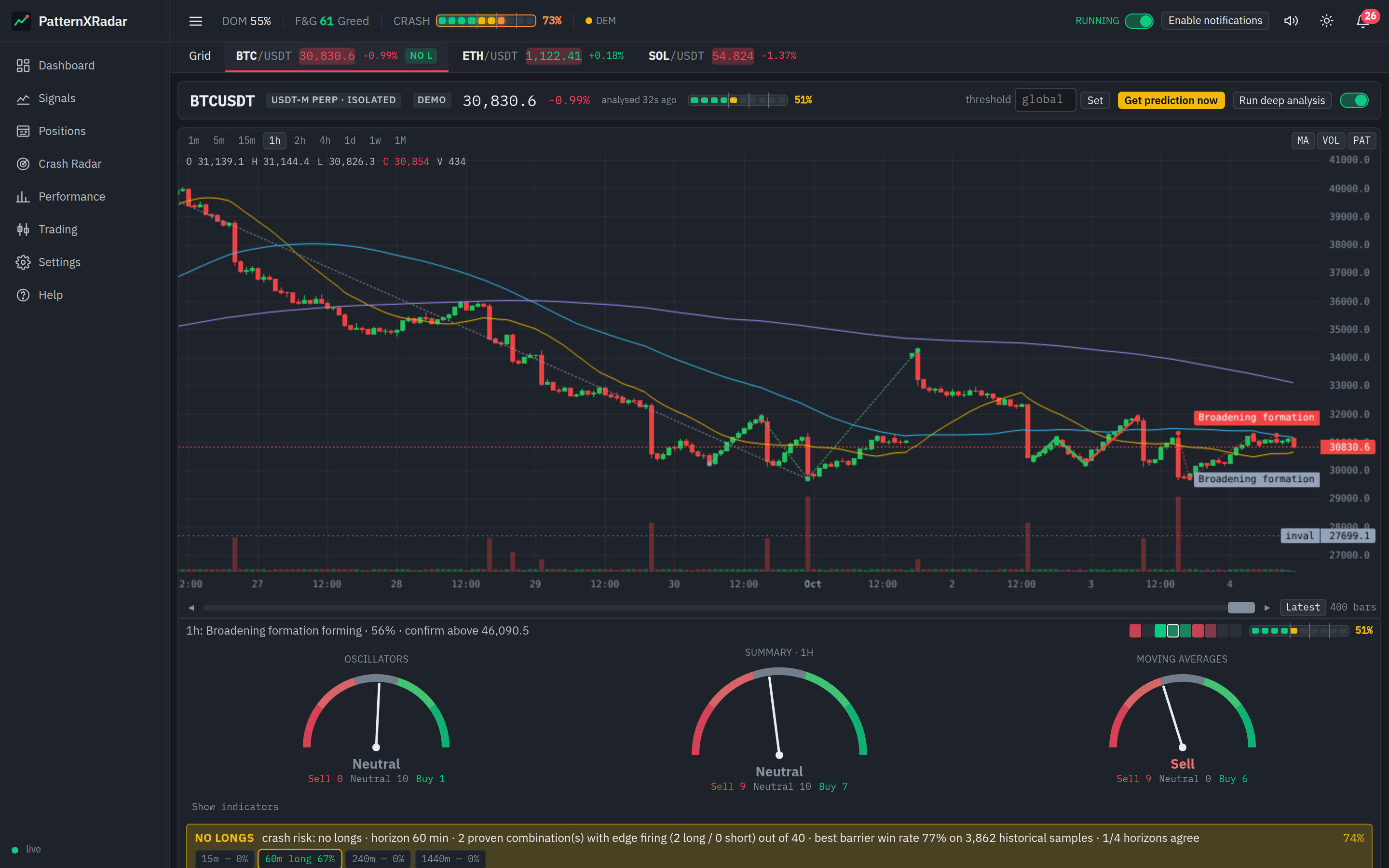
Each technique, from a pattern family to an oscillator state, a moving-average alignment, a funding extreme or a book imbalance, casts a vote per timeframe. The engine replays history to find which combinations preceded a move on this pair and horizon, and keeps only the ones that cleared a win-rate and sample-size bar.
- Headline verdict. LONG, SHORT or WAIT with the combination that is firing, its sample count, win rate and expectancy.
- Four horizons. 15 m, 60 m, 240 m and 1440 m, each scored separately against the per-pair confidence threshold.
- Trade plan. Entry range, stop, two targets with historical hit rates, risk-reward and expected bars to target.
- Vetoes. Crash risk at warning or above, OI building against the trade, taker flow dominant the wrong way, a stacked order book, crowded funding, or a strongly opposed higher-timeframe bias.
Four horizons, three confirmation levels, one cascade detector.
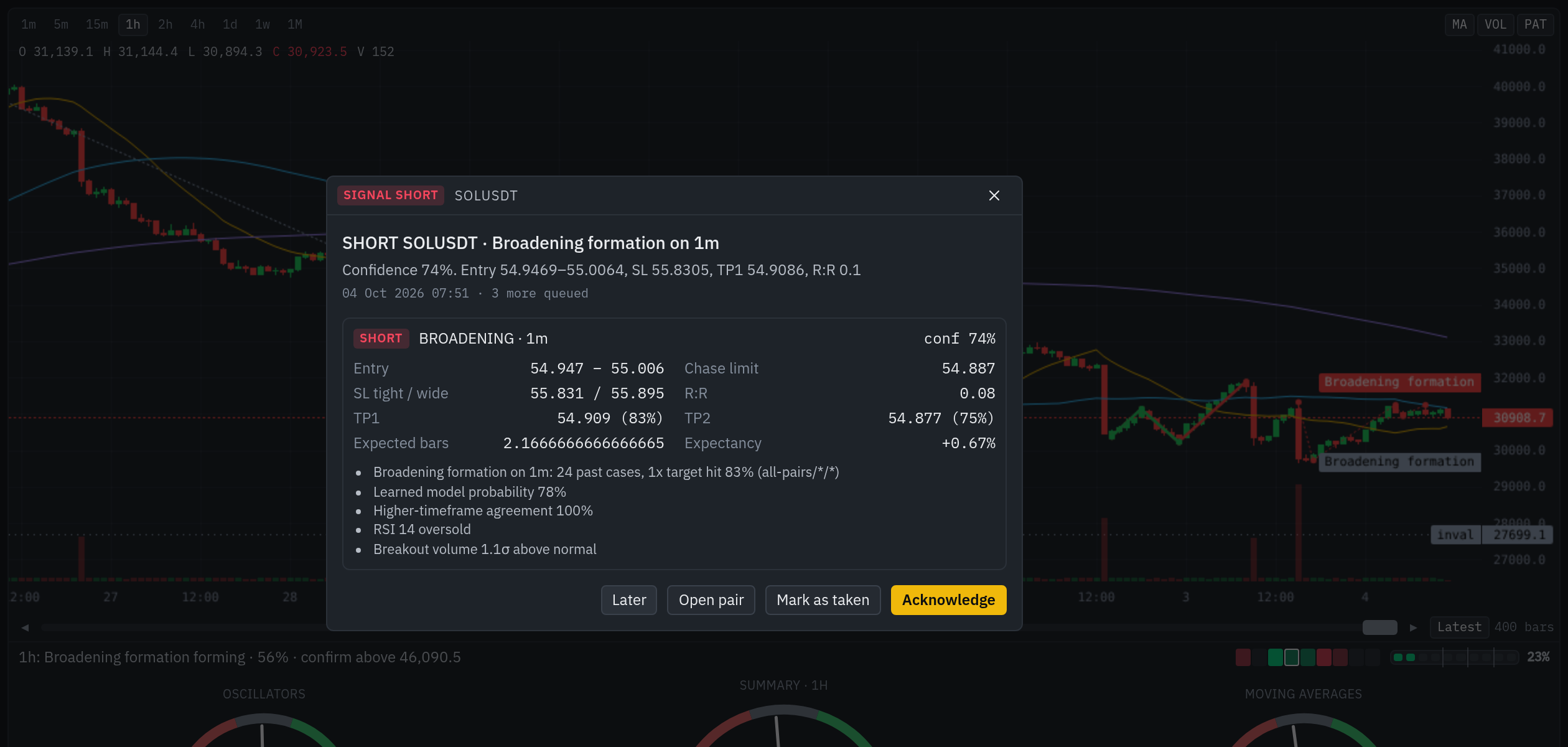
A crash is a drop of 3 % in 15 minutes, 5 % in an hour, 8 % in four or 12 % in a day, ATR-scaled per pair, with a liquidation spike or volume climax. Every such event in history is catalogued with its pre-crash window: the full feature set and the pattern permutation across timeframes.
- Rule score. Funding extreme, OI build-up with flat price, price stretched above the long averages, bearish divergence on three or more frames, rising wedge or M up high, taker selling, bid depletion, crowded longs, clustered liquidations, BTC weakening, greed extreme. Always on and explained in words.
- Boosted models. One gradient-boosted classifier per horizon on pre-crash versus normal versus near-miss windows, walk-forward validated, retrained in the background. Until there are enough labelled crashes the rule score is used alone, and the page says so.
- Confirmation levels. Watch at 40 %: a banner. Warning at 60 %: flashing border, one sound, a popup with reasons. Critical at 80 % or when the cascade detector fires: red across the app and a siren until acknowledged.
- Cascade detector. A five-second loop on liquidation burst rate, one-minute volume, bid-wall removal, BTC velocity and spread. Catches the crash the models missed, in its first seconds.
- Post-event scoring. Hit rate, false-alarm rate and lead time per level are tracked and displayed; thresholds are yours to adjust.
The nearest past situations, and what followed.
The current state of a pair, its votes across timeframes, derivatives context and crash risk, is turned into a vector and matched against every historical bar by nearest-neighbour search. The forecast is simply the distribution of what price did after the closest matches.
- Honest output. Median path, upper and lower bands, and the share of analogs that went up or down, with the dates of the matches so you can look them up on the chart.
- Not a model. No fitted curve; if the past has nothing similar the card says the frames are not ready or the matches are weak.
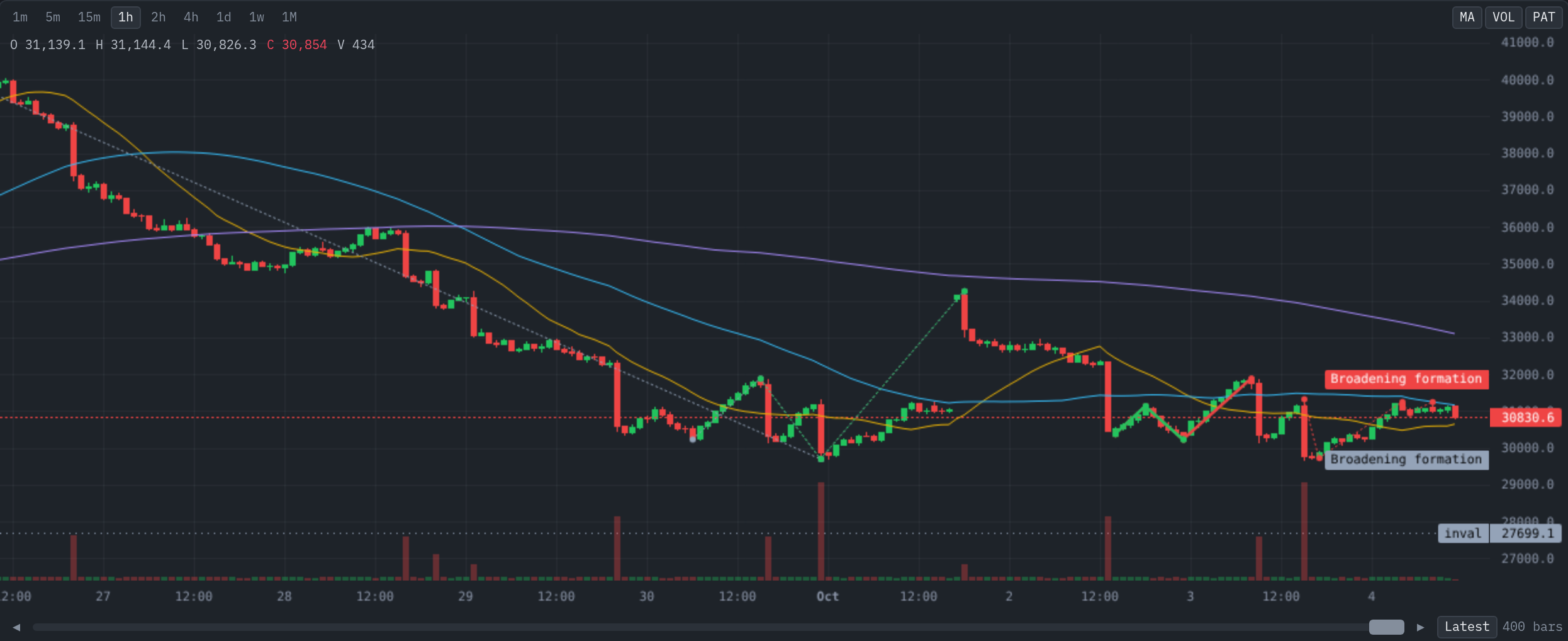
Every open position with its distance to liquidation.
Log a perpetual position by hand or take one from a signal with one click. The tracker marks it to the live price, estimates the isolated-margin liquidation for your leverage and watches the consensus and crash state on that pair for you.
- Liquidation alerts. Warning when the loss has eaten half the distance to liquidation, siren at three quarters.
- Advice per position. When the verdict turns against an open trade, or crash risk rises on it, the position shows a suggested action and the reason.
- Stop sanity. A stop beyond the liquidation price at your leverage is flagged before you rely on it.
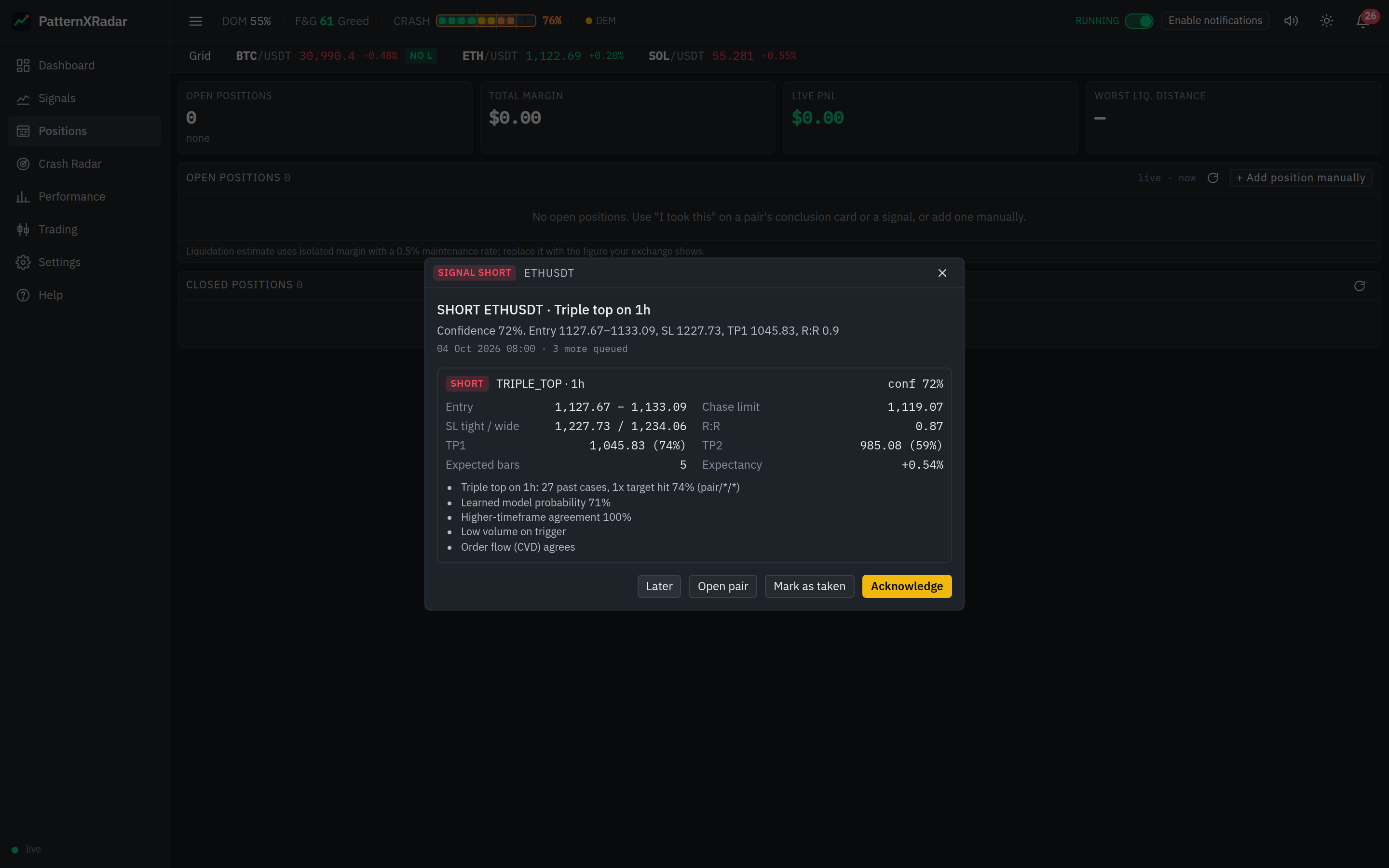
MEXC and Bybit USDT perpetuals, with a budget you set per pair and per day.
Connect an account with trade-only API keys. Orders go to USDT-margined linear perpetuals in isolated-margin mode. Keys are encrypted at rest under a password you set; the keyring unlocks for the session and locks again on demand. Paper mode uses the same executor against live best bid and ask, so going live changes only the adapter.
- Risk manager. Daily USDT budget per pair, leverage per account with per-pair override, maximum daily loss that halts trading, maximum concurrent positions, cooldown after a loss.
- Order flow. Limit entry inside the entry range with an optional chase to market; reduce-only stop and target placed immediately after the fill.
- Crash coupling. No new trade at warning risk or above; optional close-all at critical.
- Balance and status. Available, in positions and unrealised per account; test connection before enabling.
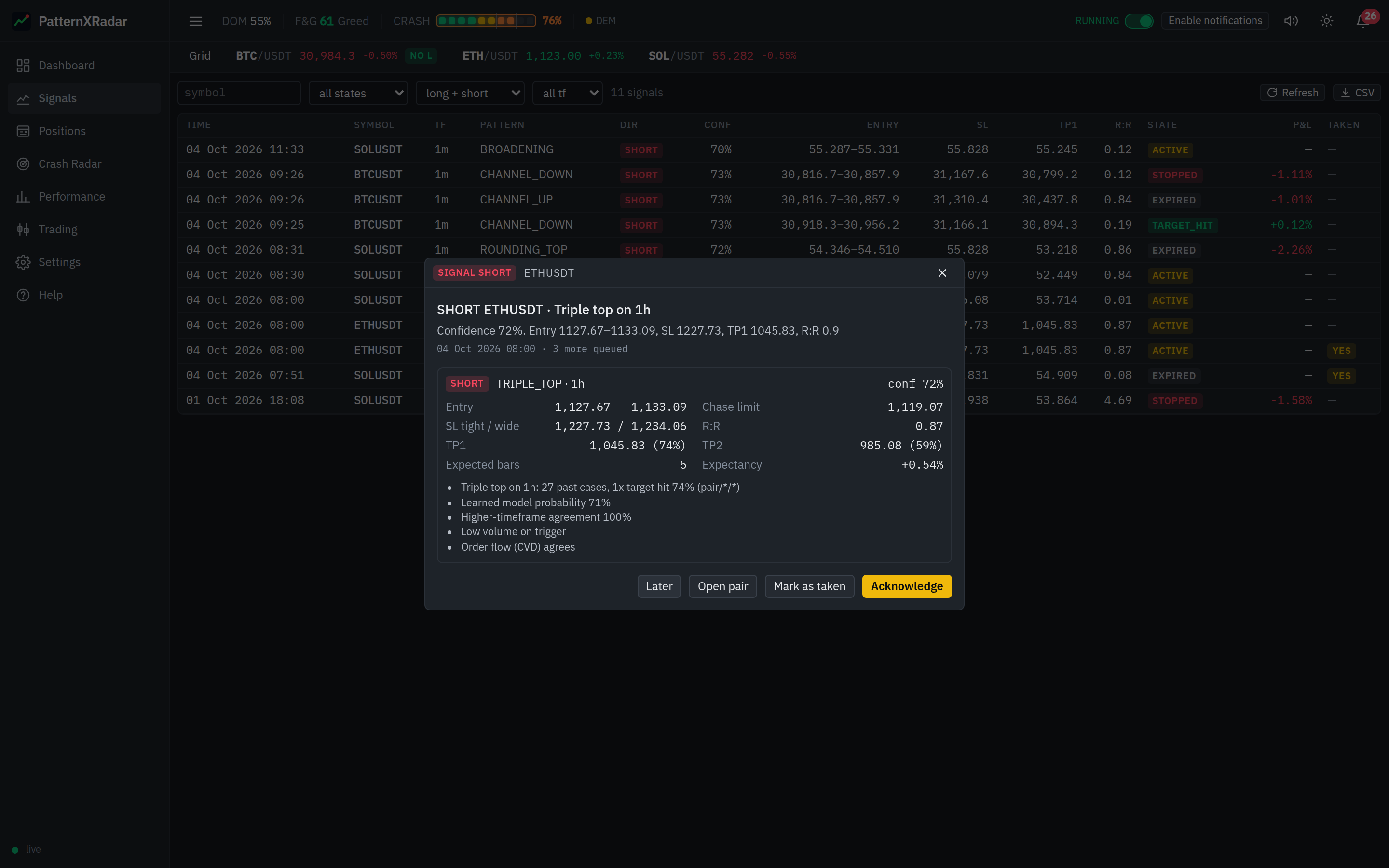
The live engine, run over the past, with fees and slippage.
There is no second implementation: the backtester calls the same pattern engine, scorer and trade-plan builder as the live loop. Taker fee, slippage, leverage and liquidation are modelled.
- Walk-forward. Train on one window, test on the next, roll. Out-of-sample win rate and expectancy are reported separately from in-sample.
- Exit policies. For the same entries, which management paid best on this pair: fixed targets, wide stop, partial at TP1 with a trailing remainder, break-even move, time stop, wobble stop. The winner becomes the suggested exit on live signals.
- Calibration. Per-pair confidence threshold chosen by the out-of-sample expectancy curve, applied automatically or on request.
- Performance page. Equity curve, win rate by pattern, timeframe and pair, drawdown, crash-alert hit and false-alarm rates, lead-time distribution.
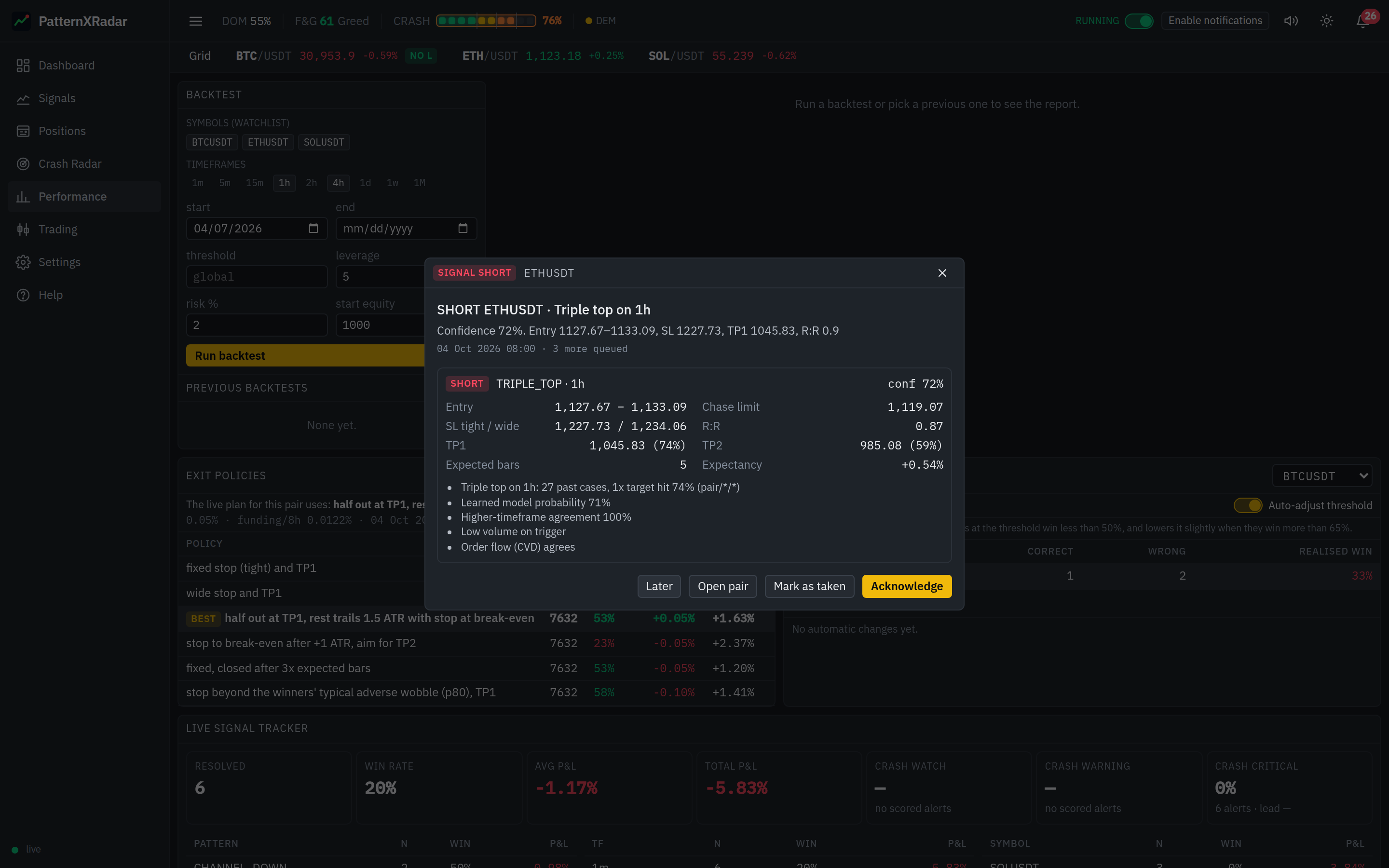
Known event windows, so a scheduled shock is not mistaken for a pattern.
Rate decisions, CPI prints, large unlocks and anything you add by hand sit on a shared calendar. Inside an event window the engine lowers its confidence and the dashboard shows why; the crash reasons name the event.
- Manual entries. Add a timestamp, a title and an impact level; it lives alongside the automatic ones.
- Visible in context. The next events and the current window are on the status bar, not buried in settings.
Event window
next 48 hWed 18:00 UTC · confidence lowered ±2 hhigh
Thu 12:30 UTCmedium
manual entrylow
Illustration. Your calendar shows the real feed plus your own entries.
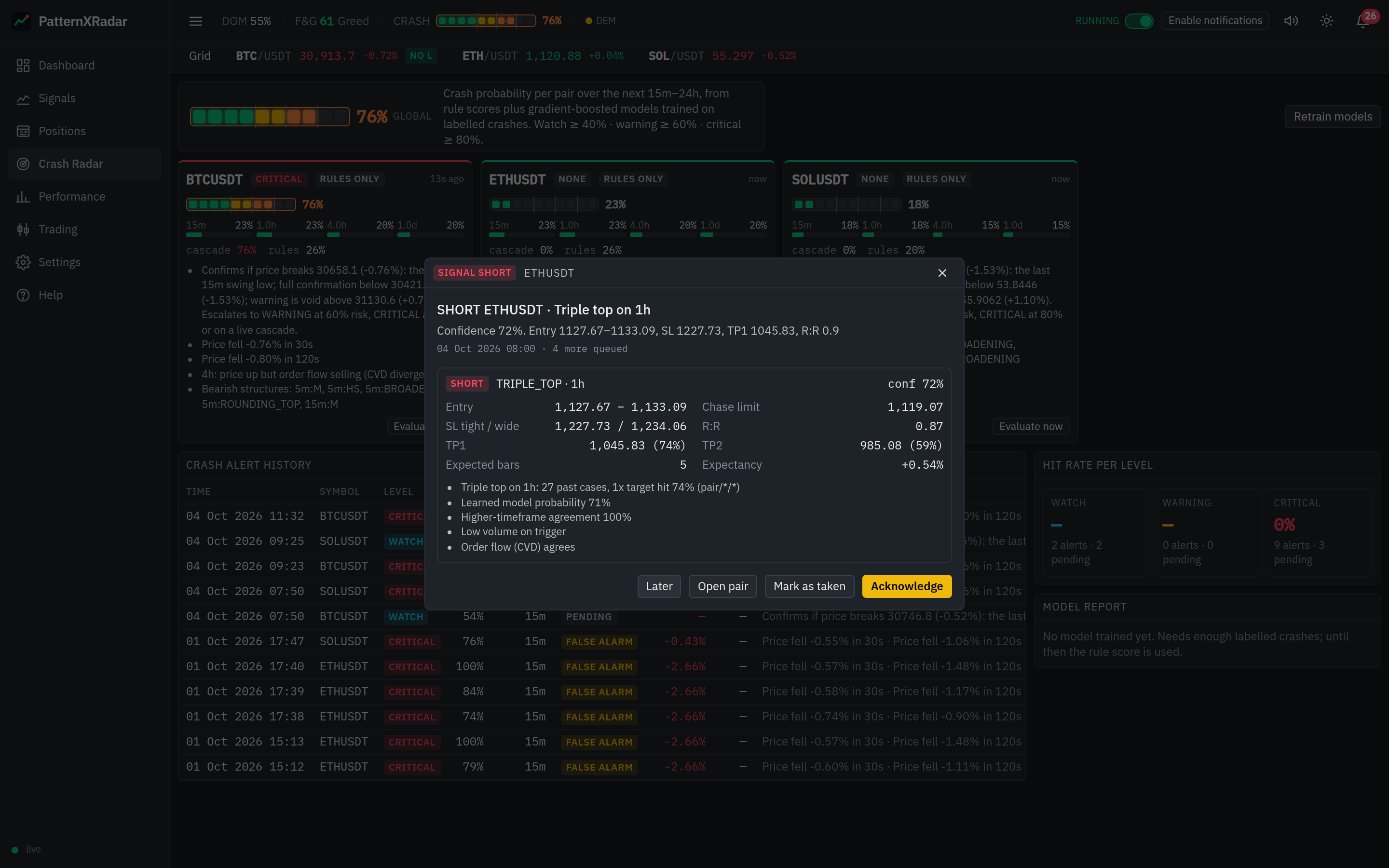
Sound, flash, popup, push. One acknowledge stops them all.
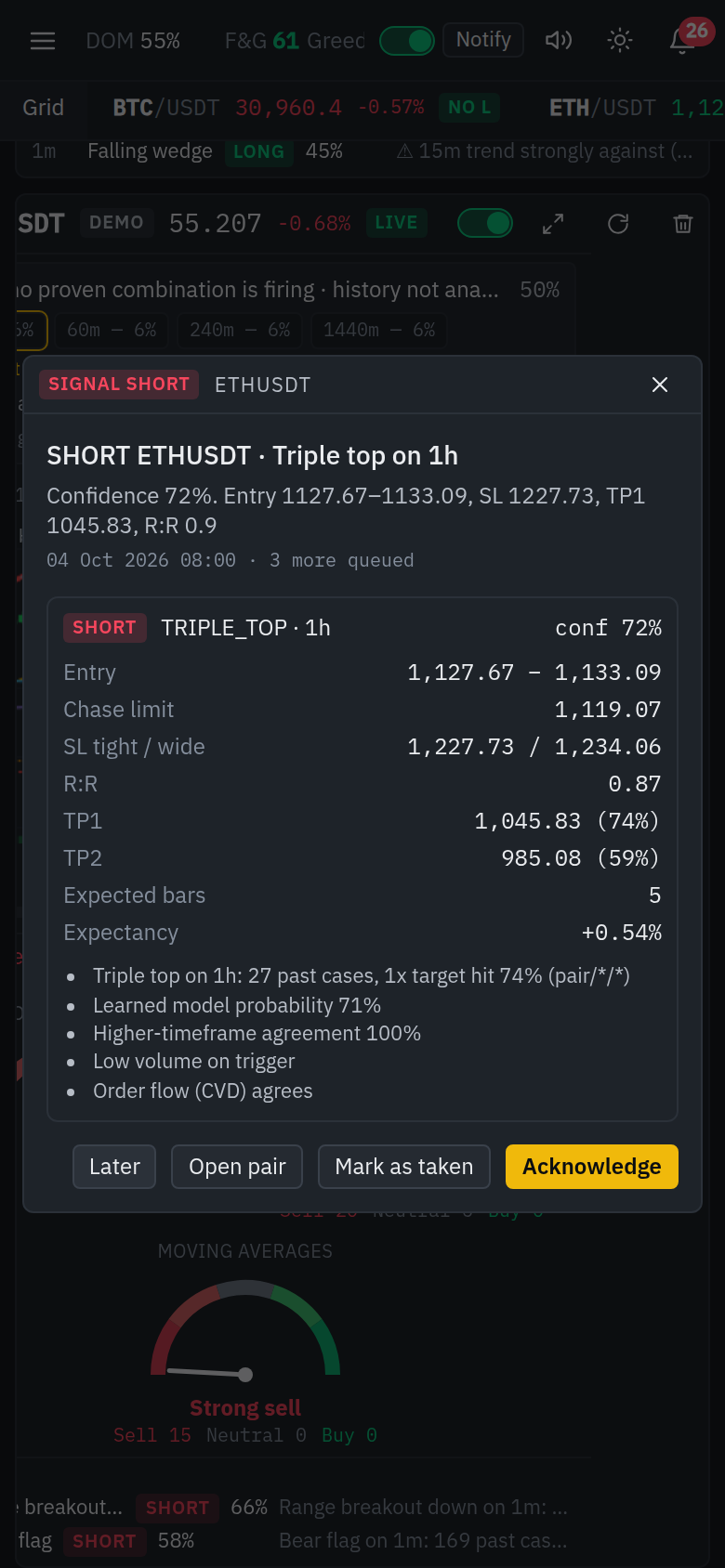
Distinct sounds for a signal, a warning and a critical. The widget border flashes green or red for a confirmed signal, orange or red for crash levels, until you click it. A popup queue never stacks more than one. Browser notifications work with the tab in the background.
- Telegram. Your own bot token, your chat; the same message text with entry, stop, targets and reasons. Per user on hosted plans.
- Persistence. Alerts survive a restart so you see what you missed, with an alert log and a per-signal "taken" mark.
- Dedupe and cooldown. No repeat of the same alert on every candle.
No vendor, no key, no monthly data bill.
Perpetual-contract candles, trades, order book, funding, open interest, long/short ratios, taker volume and liquidations come from the Binance USDⓈ-M perpetuals public REST and WebSocket, with bulk history from data.binance.vision. Bybit v5 and MEXC contract APIs are the fallbacks and switch in automatically if Binance is unreachable from the server's region.
- Depth
- 5 m and above from 2018-01-01; months before the perpetual contract existed are filled from spot prices. 1 m keeps the last year.
- Derivatives
- Exchanges expose 30 days of OI and ratio history; it is stored locally from day one and grows.
- Context
- BTC dominance and total market cap from CoinGecko, Fear & Greed from alternative.me.
- Exports
- Candles per timeframe, signals as CSV and the whole database on Elite.